How to Play in a Jazz Band Section Like a Pro:
Play in tune with the section
Play in time with the section
Play in style with the section
Play with a complementary sound color with the section
Know your role within a section
How to play in tune with a section:
Playing in tune with the section first requires that you play in tune with yourself and understand the tendencies of your playing and gear. This includes all horns, mutes, and mouthpiece combinations. Once you can do this, you need to know how your part functions within a given chord and adjust accordingly. A great section player can hear any of these adjustments and make them in a microsecond on the fly. A great section player will also adjust to the lead of their section and follow them in their tuning tendencies. This is also done on the fly within a microsecond. This is all a skill and a form of aural training that all instrumentalists have to develop over time. General ear training is also very important because it can help you figure out what your function within a chord is without theoretical analysis.
How to practice tuning:
First, be fundamentally sound on your instrument. Practice a balanced diet of fundamentals daily. Consistency in your technique is required for this level of decrement.
Secondly, practice with a tuner always, and be aware of how each note you play sits on your gear. I recommend having a tuner out of sight that you can glance at to confirm any suspicions.
Third, Practice with fixed-pitch applications and tools. Like a drone or midi, etc. This will teach you to hear the right pitch and then match said pitch. I highly recommend starting with unisons and then moving to tuning 5ths, 3rds, 4ths, and all other diatonic and non-diatonic intervals. If you can play with a fixed-pitch chord generator where specific notes are left out of the chord for you to play, this would also be beneficial.
Fourth, record yourself playing all of the parts of a trumpet section. Listen for the tuning disparities between the parts when it is just you playing in the section. Fix these tuning problems first before tackling playing in tune with others.
Fifth, record yourself playing along with recordings of others, and reflect on the tuning issues that occur.
Sixth, get together with others to record yourself playing various parts of the same piece, and reflect on intonation issues. After reflection, try to play it again and make adjustments as quickly as possible.
How to play in time with a section:
Time is the musical pulse and the consistency of that pulse. The placement of the beat and rhythmic figures within that pulse also makes up the time. Being able to emulate multiple different placements of the beat and musical figures within musical time is vital for success when playing with someone else’s musical time. Understanding your personal tendencies in this area is also needed to adjust accordingly.
How to practice time :
First, be fundamentally sound on your instrument. Practice a balanced diet of fundamentals daily. Consistency in your technique is required for this level of decrement.
Secondly, practice all of your fundamentals and music with a metronome. Use the function that randomly shuts off and turns back on to work on Tempo and time consistency.
Third, record yourself playing all of the parts of a trumpet section. Listen for the time disparities between the parts when it is just you playing in the section. Fix these problems first before tackling playing with others.
Fourth, record yourself playing along with recordings of others and reflect on the time issues when they occur.
Fifth, get together with others and record yourself playing various parts of the same piece, and reflect on issues with time. After reflection, try to play it again and make adjustments as quickly as possible.
How to play in style with the section:
First, be fundamentally sound on your instrument. Practice a balanced diet of fundamentals daily. Consistency in your technique is required for this level of decrement.
Pick an excerpt or a chart and go through the following steps:
The process is as follows:
1. Select a recording or trumpet player that you would like to study. Listen to the recording until you can sing the part perfectly, making octave adjustments as needed.
2. If possible, obtain a printed copy of the trumpet part of said recording. If a chart is unavailable, transcribe the part with the highest accuracy possible.
3. Observe how the trumpet player places the musical figures within the musical time. Note the locations where they push or pull the time and how it relates to the rhythm section and the rest of the band. I use the following exercise to help me develop my time feel: I use a metronome and practice Exercise 1, listed below, in all keys and tonalities with the metronome clicking on varying beats. I also use a metronome app called Tempo for iOS that turns the metronome off and then back on at random. Maintaining consistent time is essential in the role of the trumpet, and I aim to keep that consistency no matter where I place the melodic line within the beat. This helps bandmates follow your leadership, as stated before.
4. Observe their tone: is it laser-like? Is it broad and warm? Is it raspy or played with a growl? Make a note of this on the part. If it is raspy, identify if a growl is being applied by either a flutter tongue or growling in the throat while playing. I work on my tonal color by playing familiar melodies in all keys. It is essential to emulate our favorite-sounding trumpet players in what they play and how they play it. Observe the points where they break or extend the phrase and note this within the part. Pay special attention to how they phrase, including rests and breaks in the melodic line. I work on my phrasing by practicing long melodies and playing them in all keys and styles. Phrasing gets overlooked because it is synonymous with all forms of music. However, know that it is what separates professionals from others. I can continually refine my approach to phrasing through singing and listening to others.
5. Observe all articulations; this is a time-consuming but essential process. Listen to how and when they articulate. Take note of any articulations that are emphasized or different from others. There are generally four different articulation markings within a chart, but many shades within these markings. The first is (-); the dash above the note means legato, and a longer note is usually a "doo" articulation. The second is ( > ). This accent is traditionally played with a "ta" like articulation. The third is the marcato or “housetop” accent ( ^ ), which is played with a "dot" like articulation. Lastly is the staccato articulation ( . ), usually played with a "dit" like articulation. These articulations have many shades, are among the most personal trademarks a commercial player uses, and are determined by the era.
Exercise 1: in all keys and tonalities to work on time and play both straight and swung. Try placing the notes in different parts of the beat.
Musical Exercise 1: Keyed Time Drill
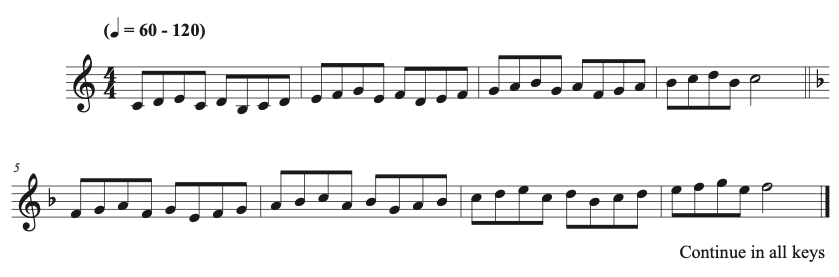
Keyed Time Drill
6. Observe the use of vibrato and focus on the speed, width, and where it occurs. Fast, frequent vibrato is a trait of the swing era. It is usually done with hand vibrato, which is quicker and more intense. A more rapid vibrato is generally used on extended notes in the 1950s–60s styles. The note is established in the said musical eras, and then the vibrato is added; take note of this nuance. In more modern pieces, vibrato is slower, wider, and often absent. When there is no vibrato, note the harmonic chord structure around the first player; if it is a cluster voicing, avoid using vibrato at that point in the chart. I work on vibrato by playing the same melodies or tunes and making them sound like they come from different eras. For example, I would play the melody to Stardust and make it sound like it was from the 1920s or ‘30s with fast, narrow vibrato, and then play it again and stylize it like it was from the 21st century.
Exercise 2 and Exercise 3: in all keys and tonalities to work on my articulations. I vary my articulations to include all the mentioned articulations. I also practice these exercises straight and swing. With Exercise 3, I will also adjust the rhythm to address my specific needs. Be creative in your Practice and compose the exercises that target your weaknesses.
Musical Exercise 2: Articulation Range Study
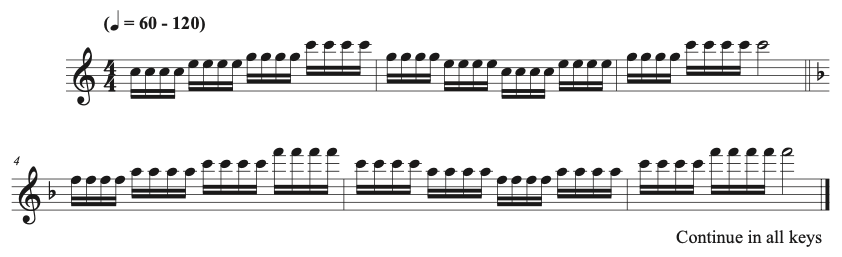
Articulation Range Study
Musical Exercise 3: Syncopated 5ths through the horn
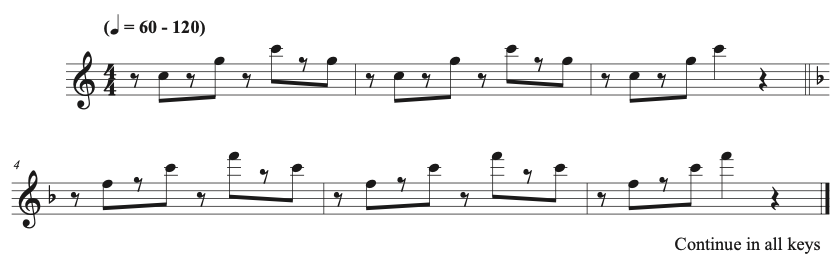
Syncopated 5ths through the horn
7. Observe the use of dynamics and focus on how the dynamics are shaded in relation to the phrasing. Take note of any overdramatized dynamics and listen to how the trumpet player’s dynamics are locked in with the comping of the rhythm section. I work on my dynamics when playing melodies in all keys and styles.
8. Observe all shakes and note their speed, width, and frequency. In general, shakes in older styles, like vibrato, the notes are established, then a fast, narrow shake is applied. Notice how the shake informs the time being played. In modern-era charts, note the shake's width and speed, and how they change over time. The way that I work on my shakes is with the following Exercise 4. I do these shakes, both narrow and wide. I transpose these into all keys and tonalities throughout the horn range.
9. Observe any falls or glissandos, their duration, and their velocity. These may be added beyond the notated part and come in various shades. Take note if a 1⁄2 valve sound is present. I add falls and other effects to melodies I practice in all keys to become more comfortable with their musical use. I also use Exercise 5, listed below, to help me discover the range needed to execute the physicality of the glissando effect. I do this exercise 3 times for each set of glissandos at three dynamic levels. I play this exercise C through G above, D through A above, and continue this pattern as high as possible.
Exercises 4 and 5 both cover specific physical techniques that can be challenging on the trumpet. Both of them have musical purposes; think about musical contexts while practicing these exercises.
Musical Exercise 4: Shakes Narrow and Wide

Shakes Narrow and Wide
Musical Exercise 5: Glissandos
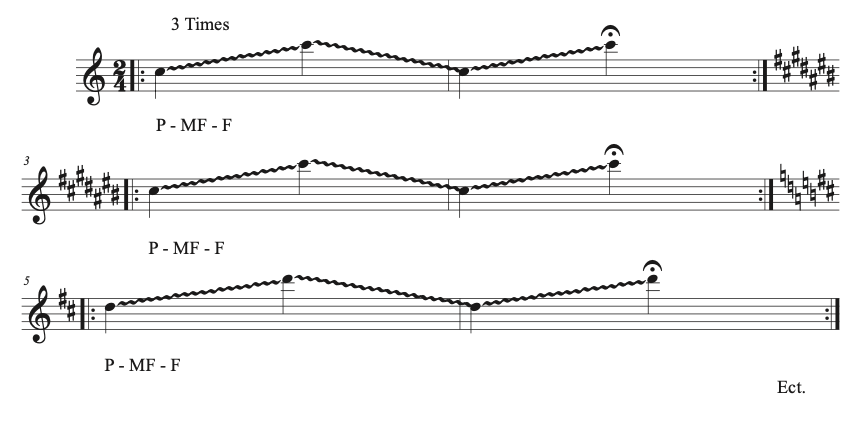
Exercise 5: Glissandos
10. Observe any bends/scoops that are applied and take note of the intended overall effect. Note if the pitch is being established and bent, or if the note is bent into the center of the pitch. Notice when a valve is used to achieve this effect or when it is executed with the embouchure. I add bends and other effects to melodies that I practice in all keys to become comfortable with their usage.
11. The last step is to play and sing with the record, matching these nuances. Being able to reproduce these nuances without reference to the recording is the actual test. Repeat this process with as many charts as possible. After studying multiple trumpet players, you will develop your stylistic approach rooted in this music's history, making your stylistic interpretations accessible to the informed listener.
Third, record yourself playing all of the parts of a trumpet section. Listen for the style disparities between the parts when it is just you playing in the section. Fix these problems first before tackling playing with others.
Fourth, get together with others to record yourself playing various parts of the same piece, and reflect on issues of style. After reflection, try to play it again and make adjustments as quickly as possible.
Fifth, after extensive listening and studying various charts, players begin to identify the specific stylistic characteristics of composers, eras, and bands. Being able to note this and recall this information is essential in this endeavor.
How to play with a complementary sound color with the section:
Understanding your own tendencies in tone color throughout the register of your instrument is the first step toward matching others to theirs. This is affected by your equipment and technique. Spending countless hours listening to great trumpet sections and observing their tone color and overall sound is the next vital step. Emulating this color and characteristic is the next step. Once you’re able to do all of this, incorporating this new skill with other people is the final step.
How to Practice Tone Color:
First, be fundamentally sound on your instrument. Practice a balanced diet of fundamentals daily. Consistency in your technique is required for this level of decrement.
Second, equipment matters when matching sound color; specific setups are designed for a soloist. Section players usually play instruments and mouthpieces that are generally middle-of-the-road, like a Yamaha or a Bach. Know your own personal tonal color characteristics and adjust accordingly. This can be done through mouthpiece selection, horn selection, and ultimately through technique adjustments.
Third, record yourself playing all of the parts of a trumpet section. Listen for the tone disparities between the parts when it is just you playing in the section. Fix these problems first before tackling playing with others.
Fourth, record yourself playing along with recordings of others and reflect on the tone issues that arise.
Fifth, get together with others and record yourself playing various parts of the same piece, and reflect on issues with tone color. After reflection, try to play it again and make adjustments as quickly as possible.
What is your role within the section:
The first trumpet is the section leader, and they dictate all of the stylistic and nuanced musicality that the written part or band leader does not convey. They are the ones you defer all questions to, and they relay them to the appropriate people. The second player has many roles. The primary responsibility of the second player, as with all other roles, is to support the lead or first trumpet player. The second typically functions as a split-lead role; the notes are lower in range than the lead player’s parts, but can be in unison or feature solo lead lines, with the second stepping in as a lead while the first trumpet player rests. The second player is typically the person who will step in when the lead player is absent or laying off a chart. The second player in a five-trumpet section functions more as a lead chair and can be a scream solo chair. The second player, often in a four-trumpet section, has lengthy solos that can function more as a jazz chair than a lead chair. The third typically is a jack-of-all-trades chair. This chair can be anything from intricate solos and jazz solos to scream lead solos to covering a lead part while the lead player rests if the second player is busy covering something else. The third part requires the widest physical range of trumpet flexibility. The fourth and fifth parts in a jazz book are where the largest amount of extended intricate solos and extended jazz solos are found. These are both considered improviser chairs in a jazz band.
In Conclusion:
Section playing is an art form that requires knowledge, experience, and skill. You must master yourself first before you can blend and match others with ease. Knowing yourself and your gear is always the first step. Then, spending countless hours listening to great trumpet sections and taking focused time to play with others will cultivate the ability to be a professional section mate. Knowing your role and playing that role with no ego is essential to success as a section mate. A section player is the ultimate team player. Before you can lead, you must first learn to follow.
